Most travelers land in Lima after dark, sleep off the altitude change that isn’t yet an altitude change, and board a flight to Cusco before the city has had a chance to say good morning. They miss everything. And what they miss isn’t just a footnote to Peru’s larger story it is, in many ways, its opening paragraph.
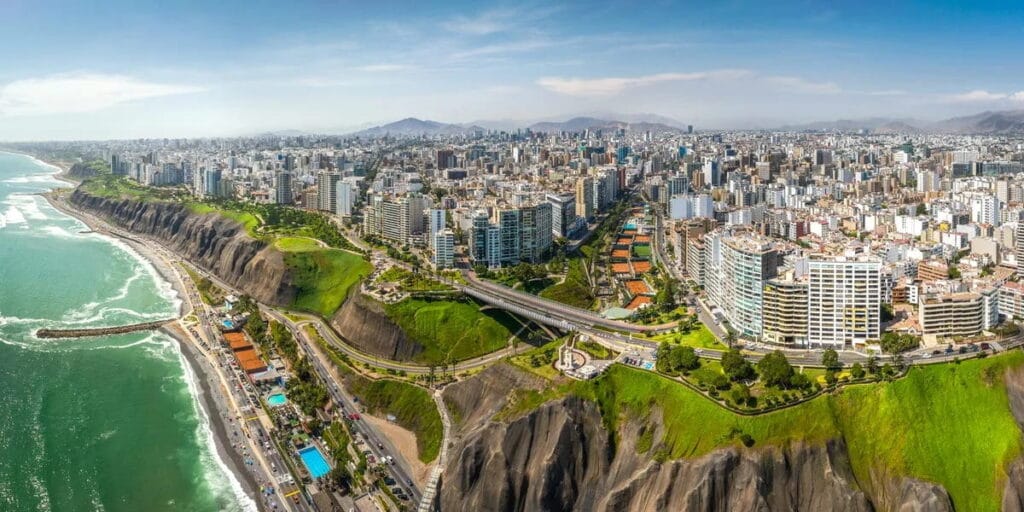
Lima, the capital city of Peru, sits at sea level between the Atacama Desert and the Pacific Ocean. For months at a time, a marine fog locals call garúa turns the skyline silver. The city is home to eleven million people, four thousand years of layered civilization, and, since 2025, the world’s best restaurant. If that last detail surprises you, it’s time to look more closely.
History Written in Stone and Baroque Gold
The Historic Center: A UNESCO World Heritage Site
UNESCO World Heritage Site, Lima’s historic center earned that designation in 1988, and walking through it today still feels like crossing a threshold between centuries.
Francisco Pizarro founded what he called the Ciudad de los Reyes, the City of Kings, on January 18, 1535. For nearly three centuries that followed, Lima served as the capital of the Viceroyalty of Peru, the political and religious center of all Spanish South America.
The Plaza de Armas, or Plaza Mayor, remains the gravitational center of Lima. The Government Palace, the Cathedral, the Archbishop’s Palace, and the Municipal Palace surround it in a configuration that has barely changed since the viceregal era.
The Convento de San Francisco deserves particular attention. It is, according to UNESCO, one of the most complete and coherent convent ensembles surviving from the colonial Americas. Beneath it runs a network of catacombs, discovered in 1943 that hold the remains of an estimated 70,000 people.
Lima’s historic center is currently undergoing its most ambitious restoration in decades. The Lima 2035 project, project is supported by a law allocating 3% of district taxes to restoration efforts. The initiative invests roughly $38 million annually in urban renewal. Walking the center now means walking alongside that process: scaffolding draped over a baroque façade here, a freshly cleaned stone portal catching the light there. The city is remembering itself.
Huaca Pucllana: A 1,500-Year-Old Pyramid in the Middle of the City
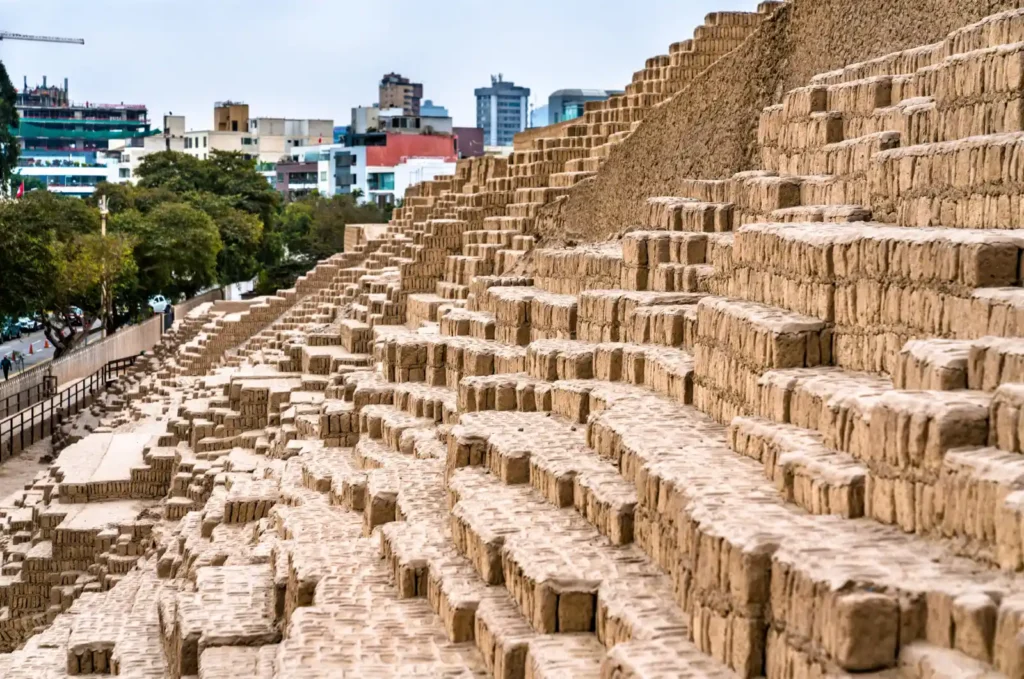
Huaca Pucllana was built by the Lima culture, a pre-Inca civilization that inhabited Peru’s central coast between roughly 200-700 CE. The site was built using the “bookshelf method.” Millions of adobe bricks were placed vertically with small gaps to absorb earthquakes. The result is a seven-tiered pyramid of extraordinary durability.
Huaca Pucllana was once the ceremonial and administrative center of the Lima culture. Its people farmed nearby valleys, fished the Pacific, and practiced ritual ceremonies.
After the site was abandoned around 700 CE, the Wari civilization reused it as an elite burial ground. Their dead were buried with silver artifacts and finely woven textiles. Centuries later, the Ychsma people arrived, added their own layers of offering and ceremony.
It was covered by sand and until the 1980s, when archaeologist Isabel Flores Espinoza began the excavations that continue today.
The World Eats in Lima
A Culinary Identity Born from Five Continents
In June 2025, Maido, Chef Mitsuharu Tsumura’s Lima restaurant, was named the best restaurant in the world at The World’s 50 Best Restaurants awards. It was the first time a Peruvian restaurant had claimed that title. Lima now has four restaurants on the World’s 50 Best list and seven on Latin America’s 50 Best.
This didn’t happen by accident, and it didn’t happen recently. It happened because Peruvian cuisine is, structurally, one of the most complex food cultures on Earth.
The story begins before the Spanish arrived. Coastal and Andean agricultural traditions produced more than 3,000 varieties of potato, along with native chile peppers, quinoa and corn. The Spanish later introduced their own culinary traditions. Enslaved Africans added techniques and flavors that would profoundly shape Peruvian cooking.
In the mid-19th century, waves of Chinese immigrants, brought to Peru as labor, adapted their cooking to local ingredients, giving birth to chifa, the Sino-Peruvian culinary fusion that produced lomo saltado and arroz chaufa. Japanese immigrants followed in the early 20th century, and their influence produced Nikkei cuisine, a discipline of restraint and precision applied to Peruvian abundance.
What resulted is not a fusion cuisine in the diluted, airport-menu sense of the word. It is a cuisine that has been arguing with itself productively for five centuries.
Where to Experience It: From Street Markets to World-Class Tables
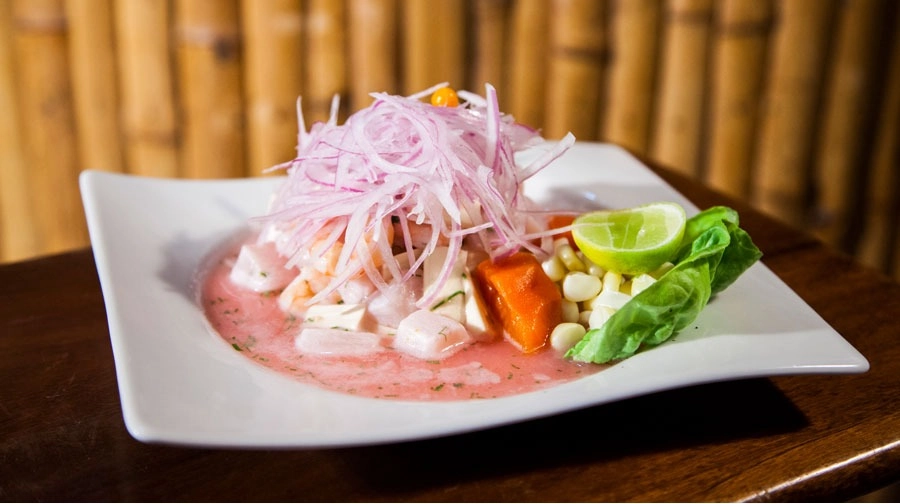
Ceviche is the city’s most honest ambassador. Raw fish, typically corvina or sea bass, marinated in leche de tigre, liquid of lime juice, ají amarillo, onion, and salt. It arrives at the table with a seriousness of purpose.
At the high end, a reservation at Central, the restaurant of Virgilio Martínez and Pía León in Barranco, is an experience that has no direct equivalent elsewhere. Instead, their tasting menus are organized by altitude. Each course represents a different Peruvian ecosystem.
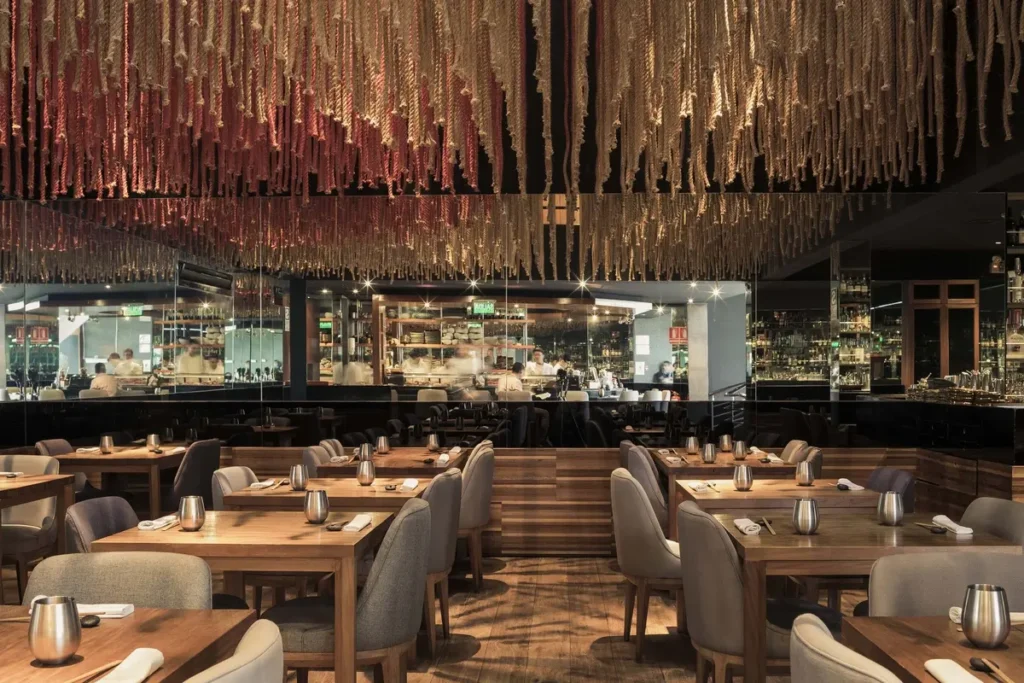
Maido, in the financial district of Miraflores, approaches the table from the Nikkei tradition, Japanese technique and precision applied to Peruvian ingredients. Its status as the world’s best restaurant in 2025 has not made it less intimate.
For a more grounded introduction to Lima’s food culture, the Mercado de Surquillo, the market adjacent to Miraflores, is one of the city’s most honest rooms. Vendors sell native potatoes in forty shades of purple and yellow, fresh ceviche prepared at market counters.
Lima’s food scene does not begin and end with tasting menus. The huariques, small family-run restaurants serving the working city, are part of the same story. The best of them serve ají de gallina, causa limeña, and lomo saltado with a confidence born of generations.
Lima’s Neighborhoods: Three Districts, Three Stories
Lima is not one city. It is a set of cities occupying the same coastline, each with its own pace and vocabulary.
Miraflores: The Modern Face of the City
Miraflores is where most international visitors land first, and there is good reason for it. Positioned on cliffs above the Pacific, connected to the airport, is usually the first impresion of Lima.
The malecón, the cliff-top promenade, runs for several kilometers above the ocean, surfaced in parks and lookout points where paragliders launch into the coastal wind. At the base of the cliffs, the Costa Verde stretches south toward Barranco.
Kennedy Park, the neighborhood’s central plaza, operates as a kind of living room. Occupied at most hours of the day by residents, street performers, and the neighborhood’s famous population of semi-feral cats, who have become, over time, part of the local identity.
Larcomar is built into Lima’s coastal cliffs. However, it functions more as a viewpoint than a shopping destination. Its terraced levels descend toward the ocean. Meanwhile, the open-air spaces offer clear Pacific sunset views.
Barranco: Art, Color, and the Pacific
The district was, in the late 19th century, Lima’s resort neighborhood, a place of summer mansions populated by the city’s elite escaping heat. Those mansions still stand, many of them converted into boutique hotels, galleries, cafés, and restaurants.
What makes Barranco distinctive now is its quality of slowness. Streets here dead-end at cliff edges with unexpected ocean views. Art galleries occupy buildings that still smell faintly of wood and age. The Bajada de los Baños, a pedestrian path that winds from the central plaza down to the beach, is lined with studios, independent shops, and the kind of wall murals that take months to paint.
The Puente de los Suspiros, or Bridge of Sighs, is Barranco’s most recognizable landmark. The wooden pedestrian bridge was built in 1876 and crosses a small ravine near the Pacific coast. Its appeal is less visual than atmospheric. The sound of the wood underfoot, the view below, and the filtered coastal light create an experience that is easier to feel than to photograph.
Barranco’s evenings shift in temperature and tone. Restaurants fill slowly, galleries stay open late, and the sound of live music drifts from the venues around the main square. It is the part of Lima where the city’s cultural life feels most visible and most unself-conscious.
The Historic Center: Colonial Grandeur
An early morning visit to the Plaza de Armas, before the day’s crowds arrive, is one of the quieter pleasures Lima offers. The cathedral’s twin towers catch the light in a particular way in the first hours of morning. The Archbishop’s Palace presents what many consider the finest example of Lima’s signature wooden balconies, long carved screens that extend over the street in intricate honeycomb patterns.
Jirón de la Unión, the pedestrianized street that links the Plaza de Armas with the Plaza San Martín, was once known as the Calle de los Mercaderes, the Street of Merchants. It still serves that function in a modern key, and walking it reveals the texture of how Lima’s colonial core lives today: functioning, inhabited, generating, not merely preserved.
Why Lima changes the way you see Peru
The Gateway That Gives Context
There is a particular quality to visiting Cusco, the Sacred Valley, or the shores of Lake Titicaca after spending three or four days in Lima: you arrive with context. And that context, as any experienced traveler will tell you, changes everything.
Consider the ceramics in the Larco Museum, pre-Columbian vessels from cultures that predate the Incas by a thousand years. Seeing them first prepares the eye for the ruins that come later. In the same way, sitting at a Nikkei table in Miraflores and tasting Japanese technique applied to Amazonian ingredients helps the traveler understand that Peru’s culinary traditions are not fixed or ancient, but constantly absorbing and transforming. Both experiences function as keys that unlock what follows.
Peru’s history, moreover, did not move from simple to complex, from primitive to sophisticated. It moved through civilizations of profound ingenuity, each building on what came before, each being overlaid by what came after. As a result, Lima is where that argument is most visible in concentrated form: five thousand years of human intelligence occupying the same coastal plain, from the adobe bricks of Huaca Pucllana to the glass towers of San Isidro.
Arriving in Cusco after Lima, therefore, is not like arriving in a country for the first time. It is like arriving in the next chapter of a book you have already begun to understand.